Built Bar Has Built a $20.4M TikTok Shop Machine While Most CPG Brands Are Still Figuring Out Their First Affiliate Post
Built Bar's official TikTok Shop store has generated approximately $20.4M in cumulative GMV across 700,300 units, ranking #4 in Food and Beverages and #260 across all US TikTok Shop sellers. The Food and Beverages category average sits at $5.8M. Built Bar is running at 3.5x that figure. That gap does not happen by accident, and it does not happen without a sophisticated operating system behind it.
For CPG brands scaling on TikTok Shop, the Built Bar numbers are not just impressive. They are a blueprint for what a mature, well-managed store actually looks like, and a useful benchmark for evaluating whether your current operator is building you something comparable.
The Hero SKU Principle: One Product Can Carry a Fifth of Your Store
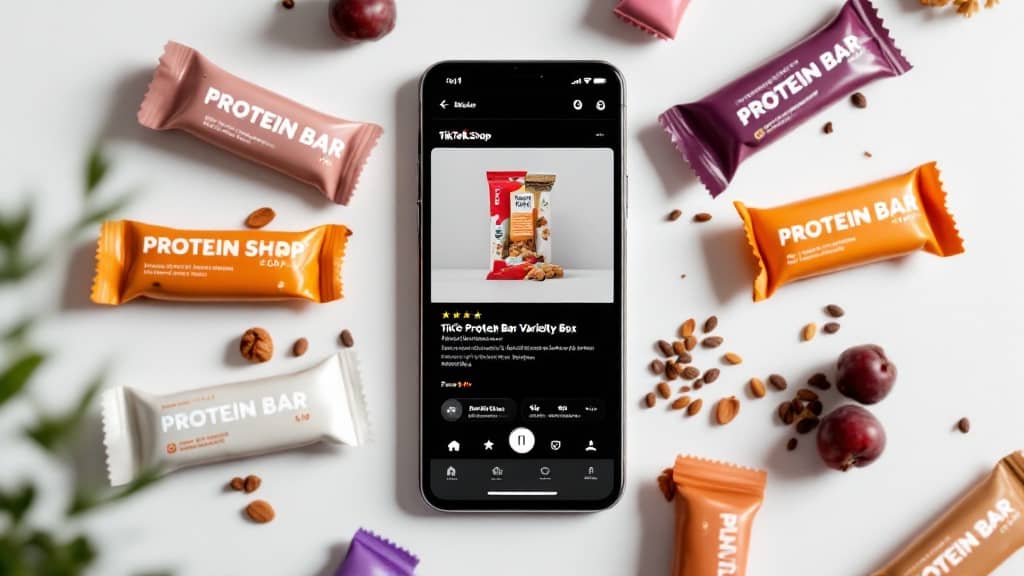
Built Bar lists 31 products currently active on TikTok Shop, with 57 listed historically. Out of that assortment, a single SKU, the Mixed Variety Box priced at $30, has generated approximately $4.39M in cumulative GMV and 155,094 units sold. Over the most recent 28-day window it ranked #1 in the store at $212,000 in GMV.
That concentration is intentional, not accidental. The Mixed Variety Box solves a specific problem that any operator managing a taste-risk category should understand immediately: purchase hesitation. Shoppers scrolling TikTok do not know whether they will like a specific flavor. A variety pack removes that friction entirely. It is a lower-stakes first purchase that converts faster and generates the review volume (12,500 plus reviews at 4.6 out of 5) needed to sustain paid amplification at scale.
What separates good TikTok Shop operators from average ones is the ability to identify which SKU in your catalog has this profile and then build the entire content and distribution system around it. Most brands spread effort across too many products and end up with no single SKU strong enough to anchor paid spend or sustain an affiliate program.
18,800 Affiliates: Scale That Requires Infrastructure, Not Just Outreach
Built Bar runs approximately 18,800 affiliates, predominantly mid-tier creators in the 10,000 to 50,000 follower range. The store has generated 63,900 shoppable videos and 24,800 shoppable livestreams. Over the trailing 28 days, creators drove 57.68% of units, with live shopping carrying another 30.39% of sales by content type.
On the hero SKU specifically, the channel breakdown over 28 days is: creators at 72% of units, self-operated content at 16%, and product card at 12%.
Running an affiliate program at this scale is not a community management task. It is a logistics and optimization problem. Someone is recruiting creators, setting commission structures (approximately 15% on the Mixed Variety Box), briefing on content angles, monitoring performance by creator tier, and rotating in new talent as content fatigue sets in. That requires dedicated infrastructure, not a brand manager with a spreadsheet.
When evaluating a TikTok Shop partner, the questions to ask are specific:
- What is their current affiliate roster size across managed brands, and what is their average activation rate?
- Do they actively recruit mid-tier creators, or do they rely on inbound applications?
- How do they structure commissions relative to category norms?
- What does their content brief process look like, and how do they measure creator-level ROAS?
A partner who cannot answer these questions in detail is not running a real affiliate operation. They are running a listing with an open collaboration tab.
Paid Amplification at 4.78 ROAS: What Good Looks Like
On the Mixed Variety Box, paid advertising over the trailing 28 days drove approximately $22,400 in estimated ad spend against $107,100 in GMV, producing a 4.78 ROAS. That is a healthy return for a competitive CPG category on TikTok Shop, and it reflects something important: paid on TikTok Shop works best when it is amplifying organic momentum, not replacing it.
Built Bar is not using paid to paper over weak organic content. The SKU already has 12,500 plus reviews, a Viral Index of 100 according to FastMoss data, and strong affiliate-driven social proof. Paid is layered on top to accelerate what is already working. That sequencing matters enormously. Brands that run paid into cold product pages with thin review counts burn budget and conclude that TikTok Shop ads do not work. The issue is not the channel; it is the order of operations.
Your operator should be able to articulate exactly when a SKU is ready for paid amplification and what organic and social proof thresholds need to be in place before ad spend is turned on.
What Built Bar's Playbook Tells You About Choosing a TikTok Shop Partner
The Built Bar store is not a collection of good decisions made in isolation. It is a system: a concentrated SKU strategy, a flavor refresh cadence that keeps content fresh, an affiliate program built for scale, a live shopping operation running alongside creator content, and paid spend layered on top of proven organic performers. Every element reinforces the others.
Building that system requires a partner who operates across all of those layers simultaneously, not an agency that handles one channel and leaves the others to you. It also requires aligned incentives. An operator who earns more when your GMV grows is going to build very differently from one collecting a flat retainer regardless of performance.
The brands that will close the gap on outliers like Built Bar over the next 18 months are the ones who find partners capable of running this full operating system and who give those partners the access and trust to execute it properly.
Doing $1M+ a year on Amazon or TikTok Shop? Book a qualification call and we'll show you where demand is leaking between the two channels.
Book a Qualification Call →