Social platforms are now search engines, and CPG brands that treat them as awareness-only channels are losing buyers at the discovery stage before a single ad dollar is spent.
Research covered by Hootsuite and behavioral data from Pew Research confirm the shift is structural, not cyclical. Pew Research found that 90% of U.S. teens use YouTube and 63% use TikTok, with one in five teens on each platform almost constantly. These are not passive scroll behaviors. These are active search sessions, and the products that surface in those sessions are the ones that win the sale.
For CPG brands doing $1M or more in annual sales, the question is not whether social search matters. It is whether your current partner understands the mechanics well enough to operate inside them.
Social Search Operates on Different Signals Than Google
Traditional search rewards domain authority, backlinks, and on-page relevance. Social search rewards watch time, saves, shares, keyword density in captions and on-screen text, and how closely a piece of content matches a user's behavioral history. On social platforms, fresh content from an unknown account can outperform an established brand if the engagement signals are strong enough. That is a different operating model entirely.
The practical implication for CPG brands: a strong operator treats your TikTok Shop listings, your product videos, and your creator briefs as search assets, not just content. Every word in a caption, every on-screen text overlay, and every hashtag choice is a signal to the algorithm about which queries your product should surface for.
An advice-only consultant will tell you this matters. A tool-only vendor will give you a keyword report. The operator who is actually inside your account will make sure those signals are consistent across every piece of content tied to your brand.
TikTok and YouTube Are Now Primary Discovery Surfaces for CPG Categories
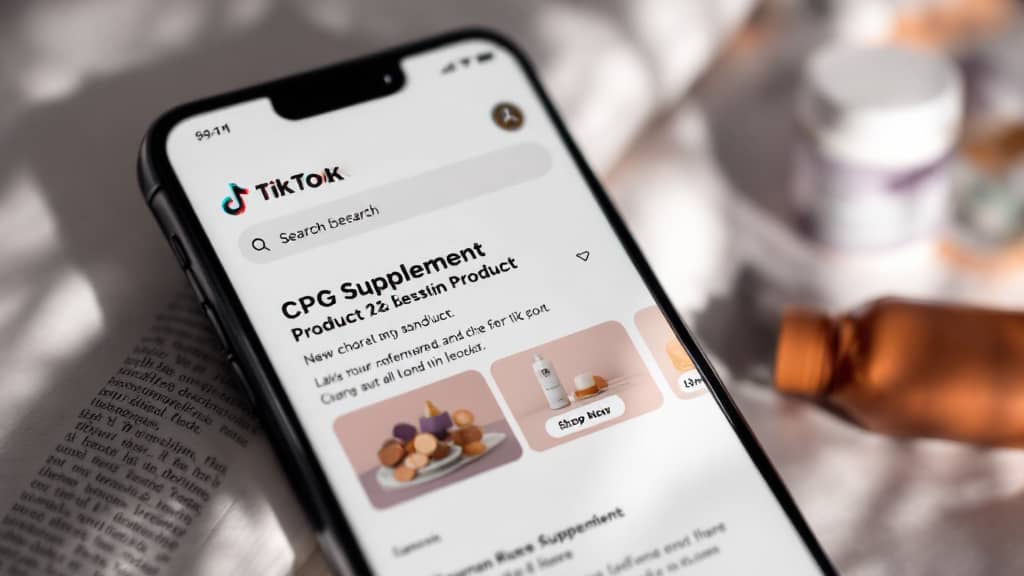
TikTok has built AI-assisted search into the core of the app, with features that surface autocomplete prompts tied to what viewers are already discussing, topic-grouped results that go well beyond simple hashtag matching, and AI-organized summaries within search pages. TikTok's own announcements from TikTok World 2025 make clear that search is a first-class surface, not a secondary feature.
This matters for CPG brands because the path from social search to purchase is now shorter than the path from Google search to purchase in many categories. A shopper searching for the best magnesium supplement on TikTok sees video reviews, creator demonstrations, and a buy button in the same session. The brand that appears in those results without a TikTok Shop presence has already lost the conversion.
Our guide to TikTok Shop for CPG brands covers what a real operating partner does to close that gap. The short version: showing up in social search and converting that visibility into revenue requires a partner who runs both the content infrastructure and the commerce backend at the same time.
What Separates a Real Operator from an Advice-Only Partner Here
Most agencies treat social search as a marketing question. The real operators treat it as a sales infrastructure question.
Here is what that distinction looks like in practice:
- A strong partner maps your product's search demand on TikTok and YouTube before any content is produced, so the brief is built around queries that actually convert, not queries that generate impressions.
- A strong partner ensures your product detail pages on Amazon and your TikTok Shop listings use the same keyword architecture, so a shopper who discovers your brand through social search lands on a listing that continues the message.
- A strong partner tracks which social search terms are driving affiliate clicks and purchase events, not just views, so the creator program is optimized on revenue, not reach.
- A strong partner knows that social posts from TikTok and Instagram are regularly indexed by Google, which means one high-performing video can generate visibility across both surfaces simultaneously.
An agency billed on a percentage of ad spend has no structural reason to care about organic social search performance. Their incentive is budget size, not brand visibility. The distributor model that never runs the agency engine cannot connect social search signals to listing optimization because those functions live in separate organizations with separate incentives.
Social Search Also Surfaces Brand Reputation, Not Just Products
When a shopper searches your brand name on TikTok or Reddit, they see reviews, complaints, unboxing reactions, and creator opinions alongside your own content. That content shapes purchase decisions before the shopper ever reaches your Amazon listing.
A real operating partner monitors those brand search results as part of the same workflow that manages your Amazon catalog. The two surfaces are not separate problems. A negative TikTok search result for your brand name suppresses Amazon conversion just as effectively as a poor review on the listing itself.
We have managed over $200 million in Amazon ad spend, scaled over 40 CPG brands, and have a 98% client retention rate. We buy inventory, contribute to ads, and operate your brand with Eleviam's internal agency arm as if it was our own.
That operating model means social search performance and Amazon catalog health are managed by the same team with the same financial stake in the outcome. Our guide to choosing an Amazon agency covers what aligned incentives actually look like across both channels.
What to Ask Your Partner About Social Search Right Now
If you are evaluating your current partner or considering a new one, these are the questions that separate operators from advisors:
- Which queries is our brand currently ranking for on TikTok search, and what is the conversion path from those results?
- How does our TikTok Shop listing keyword architecture connect to our Amazon listing keyword architecture?
- What social search terms are driving affiliate revenue, and how are creator briefs being updated to reflect that data?
- When a negative piece of content about our brand surfaces in social search, what is the operational response?
An advisor gives you a framework for thinking about these questions. An operator has already answered them and built the workflow around the answers.
Social search is not a trend to monitor. It is a distribution channel that is already moving purchase decisions in CPG categories. The brands that treat it as an operating problem, not a marketing problem, are the ones that will own the search results their competitors are not even tracking.
Want to see exactly where your brand stands? Get the free CPG Amazon Benchmark Report and see your margins, ad costs, conversion, and fees benchmarked against the real state of Amazon in 2026.
Get the Benchmark Report →