
Amazon PPC management for CPG brands.
Campaign structure, bids, search terms and negatives, run against a TACoS target rather than ACoS alone. Amazon PPC management for established CPG brands doing over $1M a year.
For CPG brands at $1M+ a year
We run Sponsored Products, Sponsored Brands and Sponsored Display against a TACoS target, so ad spend grows total sales and not just ad sales. For an organic superfoods brand with a 20% ACOS ceiling, the account averaged 18.87% ACOS at a 5.30× ROAS.
What does Amazon PPC management include?
Amazon PPC management runs the paid side of Amazon search: campaign structure for Sponsored Products, Sponsored Brands and Sponsored Display, bids and budgets, search term harvesting, negative keywords, and reporting against a TACoS target, so ad spend grows the whole business and not just ad sales. Some call it Amazon SEM or Amazon advertising services.
This page covers the campaigns. For the whole Amazon operation, including catalog, listings, account health and channel control, see our Amazon agency page. Ads can't fix a listing that doesn't convert, which is what listing optimization is for. The software we run for campaign work is in our software directory.
How it works
Products and categories separated into their own campaigns, each with exact, phrase and broad match layers, so you can see which SKUs are efficient.
Converting searches move into exact match with their own bids; searches that waste spend become negative keywords.
Sponsored Products and Sponsored Display on the detail pages of adjacent categories, and a remarketing layer for shoppers who viewed without buying.
Bids and budgets move toward the SKUs and search terms already converting under the target.
Ad spend measured against total sales, with ACoS used to judge individual campaigns. More on that in TACoS reduction.
What does Amazon PPC management look like in practice?
For an organic superfoods brand with a 20% ACOS ceiling across a wide, uneven catalog, every Sponsored Products campaign was broken out of bundled structures into SKU and category level groups, with negative keyword harvesting across every campaign. Over the campaign period the account averaged 18.87% ACOS, under the ceiling, at a 5.30× ROAS.
For a gut health supplement in a new format that shoppers were not yet searching for, the account was rebuilt as a full funnel, with Sponsored Display remarketing bringing back shoppers who had viewed without buying. Over 14 months, monthly orders went from 50 to more than 10,200 while ACOS fell from 70% to 17%. Read the superfoods and gut health case studies, or see all case studies.
Results are specific to each brand and the time period shown. Past performance does not guarantee future results.
How do Amazon's ad types fit together?
Sponsored Products and Sponsored Brands are cost per click: you set a maximum bid and pay only when a shopper clicks. Sponsored Brands features multiple products from your brand and is one of the tools Brand Registry unlocks. Display, video and audio now sit together in DVA+ inside Amazon Ads Agent.
Sources: the Amazon Ads FAQ (cost per click, bids), Amazon Brand Registry (Sponsored Brands) and Amazon's Ads Agent announcement (DVA+, which combines Sponsored Display, Sponsored TV and programmatic). Our post on what happened to Amazon DSP covers the change.
- Campaign structure, SKU by SKU
- The search term report, every week
- ACoS by campaign and TACoS for the account
- Bundled campaigns broken out by SKU and category
- Converting terms moved to exact match, waste made negative
- Budget moved toward what converts under the target
- A blended ACoS you can finally see behind
- Spend that follows the searches that convert
- One weekly read of ads against total sales
Who this is for
This is for you if
- You’re an established CPG brand doing over $1M a year across all channels
- Your ACoS is one blended number and nobody can say which SKUs are efficient
- Ad spend is growing faster than total sales
- You want spend read against TACoS, not ACoS alone
This is not for you if
- You’re under $1M a year. Foundation comes first, scaling comes second
- You want bids changed without fixing listings that don’t convert
- You only want a monthly report, not weekly decisions
How Eleviam runs it
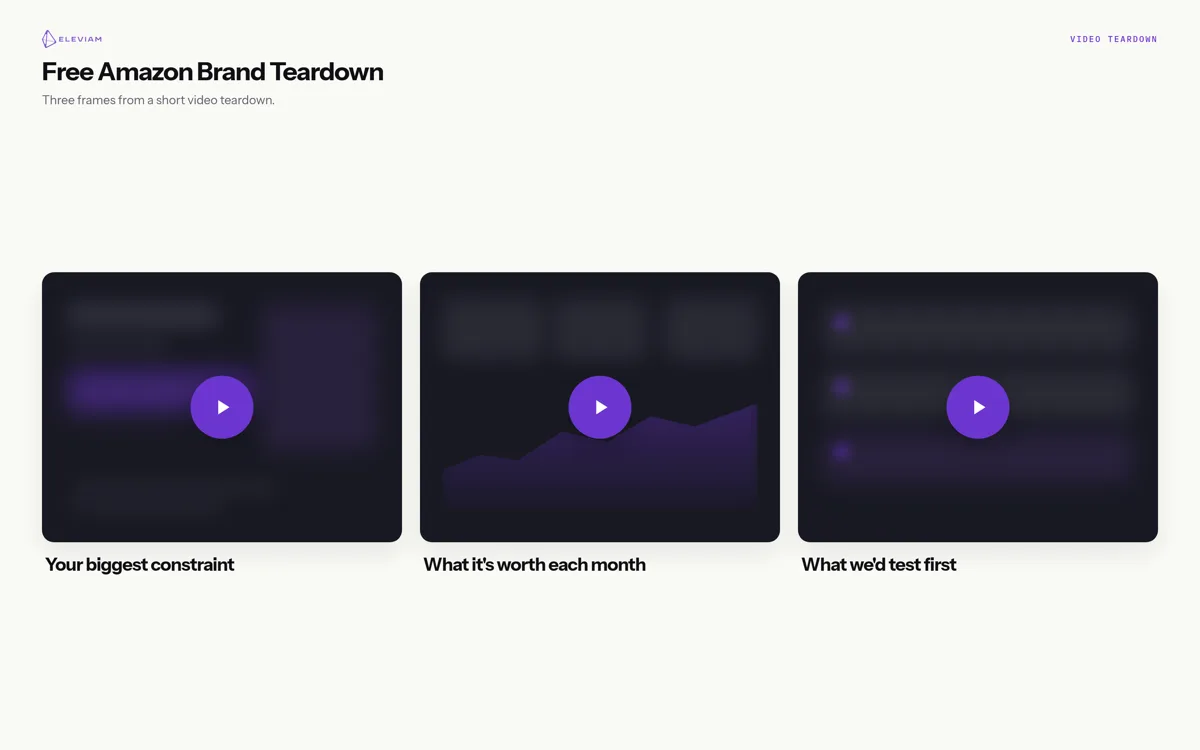
What's inside your Free Amazon Brand Teardown
We run the numbers through the same diagnostic we use for the brands we operate, then send you a short personalized video.
- 01The one constraint that matters most right nowNamed, in plain language.
- 02What it is worth each monthFigures come from public market data and are estimates, not your internal numbers.
- 03What we would test firstIf your numbers come back clean, the video says that too. No manufactured problems.
What happens after you book
Brand name, your Amazon storefront or a product link, and your annual revenue across all channels.
The same diagnostic we use for the brands we operate.
Your video lands in your inbox within one business day.
Frequently asked questions
What's the difference between Amazon PPC and Amazon SEM?+
In practice, nothing. Amazon SEM (search engine marketing) and Amazon PPC (pay per click) both describe paid ads in Amazon search, mostly Sponsored Products and Sponsored Brands, which Amazon charges for per click. Amazon SEO is the unpaid side: ranking organically for the same searches.
Do you handle Sponsored Products, Sponsored Brands, and Sponsored Display together?+
Yes, plus DSP for brands at scale. Each ad type works a different stage: Sponsored Products captures shoppers searching for the product, Sponsored Brands builds visibility for the brand and its catalog, and Sponsored Display reaches shoppers on product pages and brings back the ones who viewed without buying.
What is search term harvesting on Amazon?+
Reading the search term report to find the actual searches that triggered your ads, moving the ones that convert into exact match campaigns with their own bids, and adding the ones that waste spend as negative keywords. Done continuously across a whole catalog, it keeps spend on the searches that convert.
Why manage Amazon PPC to TACoS instead of ACoS?+
ACoS only measures ad spend against the sales the ads drove. TACoS measures ad spend against total sales, ad and organic together, so it shows whether advertising is growing the whole business. We set the target in TACoS and use ACoS to judge individual campaigns.
Should a CPG brand manage Amazon PPC in house or hire an agency?+
If someone on your team works the search term report every week and owns a TACoS target, in house can work. Brands usually bring in help when spend grows across a wide catalog and nobody can say which SKUs are actually efficient, because a single blended ACoS hides that.
How much does Amazon advertising cost?+
Amazon sets no minimum spend for sponsored ads. Sponsored Products and Sponsored Brands are cost per click: you set a maximum bid and a budget, and you pay only when a shopper clicks, with a minimum daily budget of $1. Managed campaigns run with an Amazon account executive (display, video and DVA+ with advanced settings) typically require a minimum spend. What a CPG brand should spend depends on its margins, not on a benchmark.
How does Sponsored Products bidding work?+
Sponsored Products use cost per click, auction based pricing. You choose the keywords or products to target, enter a bid, which is the most you are willing to pay for a click, and set a daily budget. The more competitive your bid, the more likely your ad is shown. Impressions are free; you pay only when a shopper clicks.
What are negative keywords, and when do you use negative exact vs negative phrase?+
Negative keywords stop your Sponsored Products ads from showing on searches you don't want. Negative exact blocks a search matching the exact phrase or a close variation, up to 10 words. Negative phrase blocks any search containing the complete phrase or close variations, up to 4 words (Amazon). Use exact to cut one wasteful search and phrase to cut a whole family of them.
What happened to Amazon DSP?+
Amazon brought sponsored ads and Amazon DSP together into one ad platform, and at unBoxed on 29 September 2026 named it Amazon Ads Agent (Amazon Ads). Amazon says the programmatic capabilities advertisers know from DSP, such as audience targeting, frequency management, deal IDs and custom bidding, now live in DVA+ with advanced settings (Amazon Ads FAQ). More in our post on what happened to Amazon DSP.
How much does Amazon PPC management cost?+
Pricing is discussed on the call, because the scope depends on your catalog and ad spend.
Ready to see what your brand is leaving on the table?
Tell us your brand. We send you a short personalized video naming the one constraint that matters most right now, what it is worth each month, and what we would test first.