The majority of Amazon agencies working with CPG brands today are optimized for their own revenue, not yours. That structural misalignment costs brands an average of 8 to 15 percentage points of net margin annually, and most brand owners never see it happening until they are already locked into a contract cycle with declining returns.
Understanding how agency incentive structures work is the single most important due diligence step a CPG brand can take before signing with any Amazon partner. The wrong partner does not just underperform. It actively works against you in ways that are difficult to detect from the outside.
The Four Archetypes That Dominate the Market (And Why Each One Falls Short)
Before evaluating any Amazon partner, a brand needs to understand the four operating models that account for nearly all agency activity in the CPG space today.
The advice-only consultant delivers strategy decks and channel audits but deploys no capital and executes nothing. These engagements feel valuable in month one. By month four, the brand is still waiting for implementation while paying a retainer for slides.
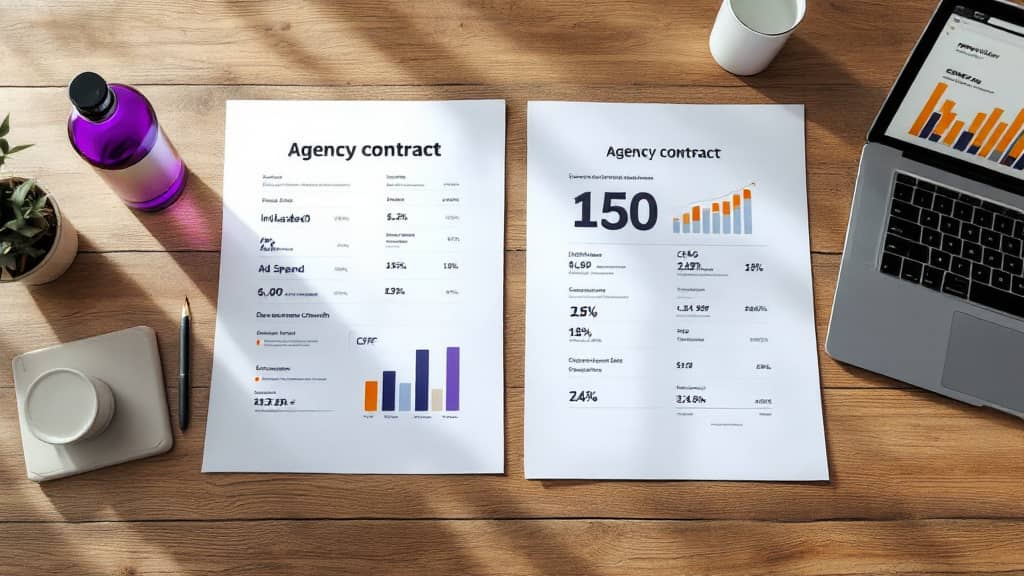
The agency billing on a percentage of ad spend is the most dangerous archetype. When a partner earns more money every time your ad budget increases, the incentive to scale spend is completely detached from whether that spend is profitable. A brand scaling from $500K to $2M in ad spend generates significantly more agency revenue regardless of whether TACOS improved or collapsed. Reducing TACOS requires an agency whose compensation actually goes down if they waste your budget, which eliminates the percentage-of-spend model entirely as a trustworthy structure.
The tool-only vendor provides software access, automated bidding, and dashboards without human strategic oversight. These platforms work well as components inside a larger operating system. As a standalone solution for CPG brands navigating listings, supply chain pressure, and retail media complexity, they are insufficient. A dashboard does not negotiate with Amazon. A human operator does.
The distributor that never runs the agency engine is the fourth archetype. Some distributors will take on your Amazon channel, warehouse your product, and handle fulfillment. What they will not do is build your brand equity, manage your advertising with strategic intent, or treat your TikTok Shop channel as a connected growth lever. Distribution without brand management is inventory movement, not channel ownership.
What a Structurally Aligned Partner Actually Does Differently
An operator-led model changes the economics of the relationship at the foundation. When a partner bills on gross revenue rather than ad spend, and when that partner deploys its own capital into inventory as a 3P seller rather than simply advising on strategy, the incentives shift. Growing your topline and protecting your margin becomes the agency's financial interest, not a secondary concern.
This is the model Eleviam operates under. Amazon and TikTok Shop are run as one connected engine, not as separate service lines billed independently. Brands working with a full-service CPG Amazon partner should expect their agency to own the advertising, the content, the retail media strategy, and the channel economics simultaneously. Siloed execution across multiple vendors produces siloed results.
Three Questions Every CPG Brand Should Ask Before Signing
- How does your fee scale when ad spend increases? If the answer is that fees rise with spend, that agency has a structural incentive to inflate your budget. A partner billing on gross revenue has the opposite incentive: spend efficiency protects margin, which protects the relationship.
- Do you deploy capital or only advise? An agency that never holds inventory, never takes a position in your SKUs, and never absorbs any financial risk is not truly aligned with your outcome. Real operator partners take risk alongside the brand.
- How do you manage the Amazon and TikTok Shop relationship together? In 2025 and into 2026, the brands capturing outsized growth are running coordinated strategies across both channels. A partner that manages only one, or manages each in isolation, is operating with an incomplete picture of how CPG commerce actually works today.
The Margin Problem Nobody Talks About
CPG brands on Amazon routinely run at 15 to 25 percent lower net margin than their DTC or retail channels, largely because of fee structures, advertising inefficiency, and uncontrolled third-party seller activity eroding the buy box. Most agencies treat these as background conditions rather than operational problems to solve.
An operator-led partner treats margin compression as a primary mandate. That means active work on Amazon margin recovery through fee auditing, packaging optimization for dimensional weight, TACOS discipline, and buy box control. These are not optional add-ons. They are the core of what separates a brand that scales profitably from one that scales into a margin trap.
What You Should Expect From the Right Partner in Year One
A structurally aligned Amazon partner should deliver measurable outcomes in the first 90 days, not a strategy roadmap for execution in month seven. Specifically, brands should see TACOS trending downward, buy box percentage moving toward 95 percent or higher, and a clear TikTok Shop revenue contribution that compounds the Amazon flywheel rather than competing with it.
If your current agency cannot show you those metrics with confidence, or if the conversation always redirects to spend increases as the solution to flat growth, the incentive structure is working exactly as designed. Just not for you.
Choosing the right Amazon partner for a CPG brand is one of the highest-leverage decisions a founder or VP of eCommerce makes. Understanding what separates genuine operator-led partners from advice-only agencies is the starting point for making that decision with clear eyes.
Want to see exactly where your brand stands? Get the free CPG Amazon Benchmark Report and see your margins, ad costs, conversion, and fees benchmarked against the real state of Amazon in 2026.
Get the Benchmark Report →