Most Brands Are Sending Paid Traffic to Detail Pages That Stop Selling Halfway Down
Amazon internal data shows Basic A+ Content can lift sales by up to 8%, and Premium A+ Content by up to 20%. Those are ceilings, not guarantees. The brands that capture meaningful lift inside that range are the ones working with operators who understand what the content actually needs to do. The brands that capture nothing are the ones who published A+ once at launch, built it from leftover gallery images, and never opened it again.
If you are spending real money on PPC, your detail page is the last line of defense between ad spend and revenue. A+ Content is where that defense either holds or collapses.
What A+ Content Actually Is
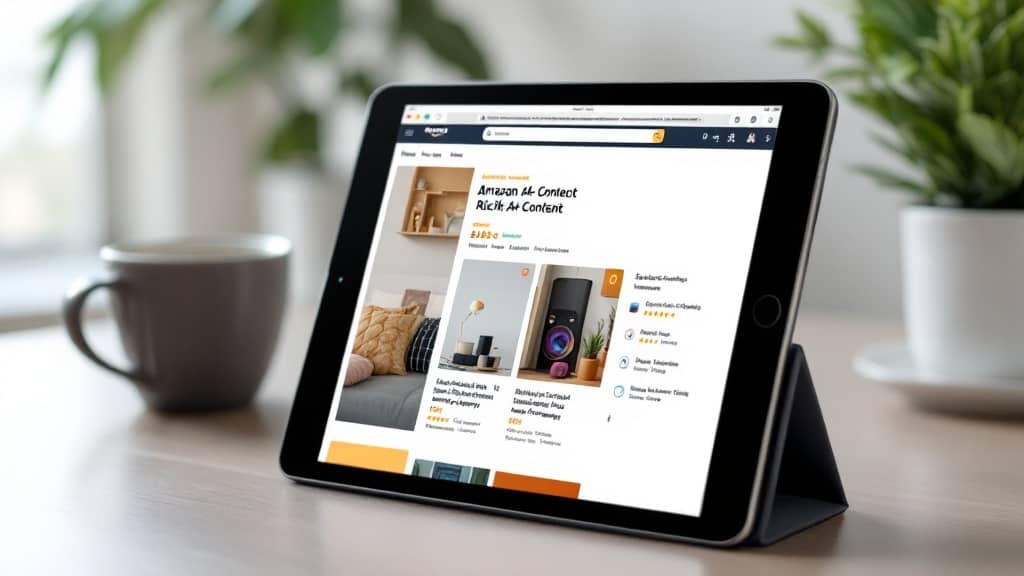
A+ Content replaces the standard plain-text product description with structured modules: lifestyle imagery, feature callouts, comparison charts, text blocks, and a Brand Story banner that carries across your catalog. It appears below the bullet points on the detail page and comes in two tiers.
Basic covers standard image-and-text layouts and comparison charts. Premium adds video, interactive hotspot modules, clickable carousels, larger imagery, and Q&A sections. Both tiers are free for eligible sellers. The feature has been available to third-party sellers since 2016, when Amazon offered it under the Enhanced Brand Content name before consolidating it into the A+ system.
Who Qualifies and What It Costs
Eligibility requires a Professional selling account and a Brand Representative or Reseller role on a brand enrolled in Amazon Brand Registry. Amazon has also opened eligibility to sellers with generic products in their catalog, which is a meaningful expansion from the Brand-Registry-only rules that most older guides still describe.
Premium A+ is broadly available in 2026 to brand-registered sellers, though Amazon adjusts the qualification criteria without publishing a fixed rule set. The A+ Content Manager in Seller Central is where you confirm your current status. If Premium is available on your account and the ASIN has real traffic, leaving it unused is a straightforward margin leak.
What Separates Lift From No Lift
Amazon's published figures are directional. What actually determines whether you capture any of that range is whether the content resolves the doubts that stop purchases before they happen.
The pattern across high-performing accounts is consistent. A+ Content produces meaningful conversion improvement when it does the following:
- Addresses specific pre-purchase objections that the bullets cannot fully resolve, typically around sizing, compatibility, use cases, or ingredient concerns for CPG products
- Uses imagery that shows the product in context rather than restating the packaging against a white background
- Frames the comparison chart around real purchase alternatives, not internal SKU comparisons that mean nothing to a first-time buyer
- Builds a Brand Story that creates purchase confidence rather than reading as a mission statement nobody asked for
A page built from leftover gallery images, with text modules that restate the bullets in a larger font, captures roughly none of Amazon's published lift range. It looks finished. It does not convert.
The SEO Question Most Guides Get Wrong
A+ body text has historically not been indexed for Amazon keyword search. Keyword-stuffing your text modules will not move organic ranking directly. That is the first part of the answer, and it is the only part most guides give you.
The second part is that conversion rate is a ranking signal. A+ Content that materially improves conversion on a high-traffic ASIN creates a compounding effect on organic placement over time. The content does not rank directly; the sales velocity it produces does.
The third part matters heading into 2026 specifically. Amazon's AI systems, including the generative features that surface product recommendations and answer buyer questions, extract structured information from your detail page content. A+ modules that are built with clear, specific, well-organized information feed those systems more usefully than a wall of unstructured text. Brands that treat A+ as an AI data layer, not just a design element, are positioning their listings better for how Amazon's discovery layer is evolving.
Testing: The Only Way to Know What Your Change Did
Manage Your Experiments, Amazon's built-in A/B testing tool, splits detail page traffic between two versions and reports on conversion rate, units sold, and projected annual revenue impact. It requires a Professional account, Brand Registry enrollment, and sufficient recent traffic on the ASIN to generate statistically valid results.
Your highest-traffic ASINs are where testing produces usable data in a reasonable timeframe. Lower-traffic listings can take months to reach significance. A good operator prioritizes testing on the ASINs where the answer will move actual revenue, then applies learnings across the catalog systematically rather than iterating randomly.
What Your Agency Should Be Doing With A+ in 2026
The brands seeing consistent lift share a common operating approach. Their A+ Content is built from customer research, not brand asset libraries. It is tested systematically using Manage Your Experiments on priority ASINs. It is updated when the competitive set shifts, when reviews surface new objections, or when seasonal context changes purchase behavior. And it is structured to feed Amazon's AI extraction layer, not just to look polished in a screenshot.
If your current agency built your A+ pages at onboarding and has not touched them since, that is worth examining. The cost of publishing A+ is zero. The cost of bad A+ is every conversion the page fails to close after your ad spend delivered the click.
At Eleviam, A+ Content is not a deliverable we hand off. It is part of an integrated account system where creative, keyword strategy, PPC, and listing optimization operate as one unit with a shared revenue objective. That alignment is what separates accounts that scale from accounts that plateau.
Doing $1M+ a year on Amazon or TikTok Shop? Book a qualification call and we'll show you where demand is leaking between the two channels.
Book a Qualification Call →