Brands that treat Amazon as a static catalog listing are losing ground to competitors whose partners deploy AI-driven demand signals, dynamic pricing logic, and content optimization across every SKU, every week.
The shift is not theoretical. AI tools embedded inside modern marketplace operations are compressing the gap between data collection and action from weeks to hours. For CPG brands doing $1M or more annually on Amazon, that compression is the difference between holding margin and watching it erode one lost Buy Box or one bloated ad spend at a time.
The real question is not whether AI matters for your Amazon business. It is whether your current partner is actually using it, or just talking about it on sales calls.
What AI Actually Does in a High-Performance Amazon Operation
Strip away the buzzwords and AI in marketplace management comes down to three practical applications: inventory forecasting, advertising bid optimization, and content scoring. Each one sounds simple. Executing all three in a coordinated way, at scale, across hundreds of ASINs, is where most agencies fall short.
Inventory forecasting powered by machine learning does not just look at last year's sell-through rate. It pulls in seasonality curves, competitor stockout patterns, promotional calendars, and lead time variability to build a replenishment model that keeps you in stock without over-capitalization in FBA warehouses. A partner who is still running static reorder points is leaving cash tied up in working capital while also leaving you exposed to ranking drops every time you go out of stock.
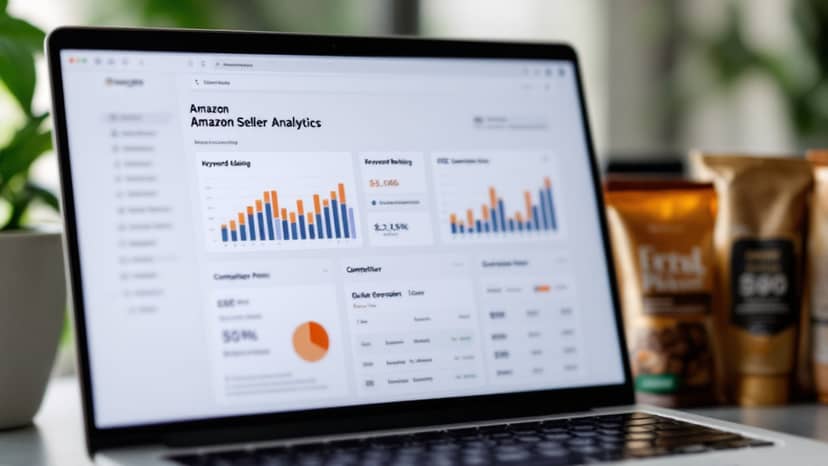
On the advertising side, bid optimization tools process thousands of keyword and placement signals per hour. An agency billed on a percentage of ad spend has a structural incentive to increase that spend, not reduce it. An operator-first partner whose fees are tied to gross revenue has the opposite incentive: drive efficient growth so the top line scales without the ad cost percentage ballooning alongside it. That alignment matters enormously when AI tools are making hundreds of micro-decisions daily about where your budget flows. If you want to understand what healthy ad efficiency looks like for your category, Eleviam's work on Amazon TACoS reduction is a useful benchmark.
Content Optimization Is Not a One-Time Task
One area where AI is creating a persistent competitive advantage is content scoring and iteration. The brands winning search real estate on Amazon are not the ones who wrote good copy at launch and walked away. They are the ones whose partners run continuous A/B testing on titles, bullet points, and images using conversion signals to identify which version of a listing drives the most add-to-cart events per session.
An advice-only consultant will hand you a content audit and a list of recommendations. A tool-only vendor will give you a dashboard showing your content score. Neither one executes the actual changes, monitors the outcome, and iterates again. The operator model closes that loop by owning the execution alongside the strategy.
TikTok Shop Is the AI-Powered Discovery Layer Amazon Cannot Replicate
AI is not just reshaping how products are managed on Amazon. It is reshaping how consumers discover them in the first place. TikTok's recommendation engine is the most commercially effective AI-driven discovery surface in consumer packaged goods right now. Content that aligns with a creator's organic posting behavior gets surfaced to purchase-ready audiences with a precision that paid social channels have not matched.
For CPG brands, this creates a specific opportunity and a specific risk. The opportunity: TikTok Shop drives first-time trial at a cost per acquisition that can be significantly lower than Amazon PPC for cold audiences. The risk: brands that operate TikTok Shop and Amazon as separate channels, managed by separate vendors, miss the flywheel. A spike in TikTok sales drives search velocity on Amazon. Amazon ranking improves. Amazon then converts the repeat purchaser at a lower cost because brand recognition is already established. If your TikTok Shop partner and your Amazon partner are not talking to each other, you are leaving that flywheel on the table. This is exactly why integrated TikTok Shop management needs to be connected to your Amazon operation rather than siloed.
The Distributor Problem in an AI-First World
Some brands are approached by distributors who offer 3P placement on Amazon as part of a wholesale arrangement. The pitch sounds clean: no operational overhead, guaranteed purchase orders, simplified logistics. The problem is that a distributor who does not run the agency engine has no ability to deploy AI tools in any meaningful way against your listings. They are not optimizing bids. They are not iterating content. They are not coordinating TikTok Shop discovery with Amazon conversion. They are holding inventory and hoping the catalog sells itself.
As AI raises the performance ceiling for well-managed brands, the gap between an actively operated listing and a passively held one widens every month. Distributors who cannot run the agency function will increasingly struggle to maintain competitive positioning for the brands in their portfolio.
What to Look for in a Partner Who Actually Uses AI
When evaluating whether a partner is genuinely AI-driven or just AI-adjacent, ask four specific questions. First, what specific tools are embedded in your bid management workflow and how often are they recalibrating? Second, how do you use demand signals outside of Amazon, including social and search trend data, to inform inventory replenishment? Third, can you show me before-and-after data from a content optimization test you ran in the last 90 days? Fourth, how does your TikTok Shop operation feed data back into your Amazon strategy for the same brand?
A partner who can answer all four with specifics, real numbers, and real examples, is operating at a fundamentally different level than one who responds with process descriptions and category averages. For CPG brands evaluating the full landscape of options, the criteria for choosing an Amazon agency should now include AI capability as a primary filter, not an afterthought.
The brands that win the next three years on Amazon and TikTok Shop will be the ones whose partners are running integrated, AI-informed operations today. The cost of waiting is not standing still. It is falling behind a competitor who already made the switch.
Want to see exactly where your brand stands? Get the free CPG Amazon Benchmark Report and see your margins, ad costs, conversion, and fees benchmarked against the real state of Amazon in 2026.
Get the Benchmark Report →